![Veridiction Consulting, Independent Educational Consultant [Logo]](https://veridiction.com/wp-content/uploads/2025/07/cropped-cropped-Image-1.png)
Today we’re going to work on improving your memory and making you memorable. 📨
- Get a pen of good but not irreplaceable quality with dark—but not necessarily blue or black—ink. Pilot G2 pens are a popular choice.
- If your handwriting is not already consistent, clear, and distinctly legible to other people then use those pens to very specifically practice your lettering skills for a few minutes a day. ✍️
- YouTube has videos on improving your handwriting
- Going into full-on calligraphy is probably overkill (but can be fun).
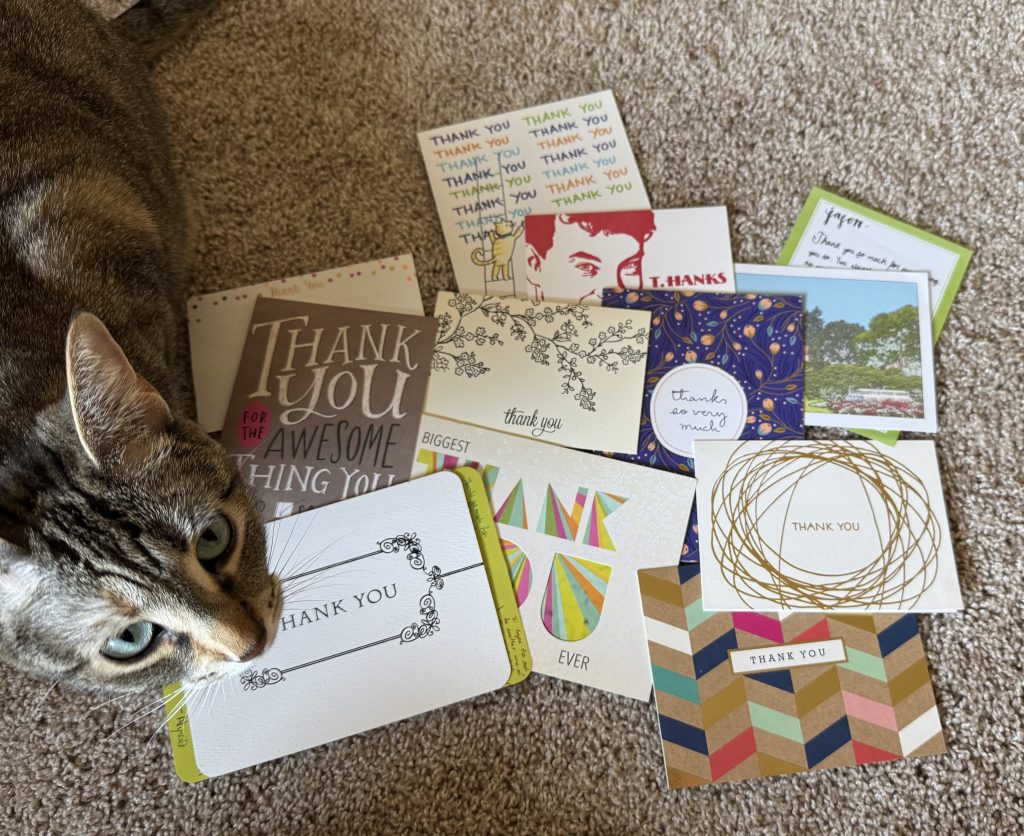
- Purchase a stockpile of 20-40 physical, simple, blank Thank You cards with envelopes (simple or fancy) and stamps.
- ⚠️ Do not choose cards that are too clever or cute; prefer elegance.
- Set aside 3-4 cards for the teachers, coaches, and counselors who will be writing you recommendations.
- Now, after every college visitation, write and mail a Thank You card to up to 3 people you spent time talking with: an admissions interviewer, a professor and/or coach, and (if applicable) a student host relevant to your studies (especially if you did an overnight visit).
A simple formula for these post-visitation notes to get you past immediate-term writer’s block goes as follows:
- Salutation: “Dear [recipient],” ⬅ being sure to include the “Dr.” title if they have a PhD as most professors do.
- First line: “Thank you for taking the time to [speak with or host] me during my visit to [institution] last week(end).” ⬅ This is a generic reminder of where you met them to re-establish your point of relationship.
- Second line: “I really appreciate you sharing your perspective on [a process, department, team, or living conditions] at [institution] as it is important to my decision-making process.” ⬅ This is where you re-indicate your durable interest in their particular niche.
- Third line: “I was particularly (intrigued with, keen on, or fascinated by) [a unique detail from the conversation] and will be thinking more about that in the days to come.” ⬅ This is the key line where you make that person feel specifically appreciated for something they-and-only-they shared with you.
- Closing line: “Thank you again for your (time or consideration).” ⬅ A nice generic exit line.
- Signature: “Sincerely, [Your Name]”
And get those in the mail promptly (within 3 business days after your visit) so that they arrive before you’ve completely faded from the recipients’ memories. You can follow a similar sort of formula for the people writing/who wrote recommendations for you, though I’d hope you’d give them something slightly more detailed and personal in reciprocation for how you wanted them to be advocating for you.
Why are we doing this? Many reasons.
- Handwriting is good, actually. As we’ve known for over a decade, handwriting notes is a better stimulant for memory than typing them, and this is routinely re-confirmed (Pittard, 2026; Rosen, 2025). As subsequently described by Audrey van der Meer (2020):
The use of pen and paper gives the brain more “hooks” to hang your memories on. Writing by hand creates much more activity in the sensorimotor parts of the brain. A lot of senses are activated by pressing the pen on paper, seeing the letters you write and hearing the sound you make while writing. These sense experiences create contact between different parts of the brain and open the brain up for learning. We both learn better and remember better, so it’s important for children to go through the tiring phase of learning to write by hand, even though it can take longer.
- Actively remembering things that you’re grateful for will make you a happier person — see 10:55 in this Achor (2011) video citing Emmons & McCullough (2003). So it’s good for you even if none of the rest of this pans out in your tangible favor.
- Sending the physical card demonstrates what should be a recurring theme on your activities list: that you, unlike most of your generation, are intentionally practicing the interpersonal social graces to form and maintain cohesive groups. As Shawn Achor (2013) writes: “The people who actively invest in their relationships are the heart and soul of a thriving organization, … In sports, these people are called ‘glue guys.’ … ‘quietly hold[ing] winning teams together.… Statisticians don’t buy that they exist, but psychologists do. And players and managers swear by them.’” (pp. 187-8) And this is valuable to the admissions officer trying to build a class cohort, the coach trying to form a team, and the professor looking to staff a lab.
- You need a communication to manifest the social reality of your relationship with this person, and you’ll prefer a physical token (the card) to close that loop separate from the emails your anonymous peers may send. As anthropologist Mary Douglas (2005) explains: “Without the letters of condolence, telegrams of congratulations and even occasional postcards, the friendship of a separated friend is not a social reality. It has no existence without the rites of friendship. Social rituals create a reality which would be nothing without them. … it is impossible to have social relations without symbolic acts.” (pp. 99-100). But really, the rarity of the physical card in modern times makes folks like us—as confirmed by admissions and financial aid workers from Reed to Penn State—delighted by their novelty: we keep them where we can see them and think favorably of you during our working days.
- Finally, extending on the modern novelty, the card is a high-class behavior that signals readiness for upward-mobility. Cutting through the aristocratic nonsense, the short of it is that you’re signaling that you’ve got social capital to invest even if you don’t. More importantly, the meta here is that by you showing you know this signaling behavior, a professor or coach or upperclass student host can recognize that you are safe for them to introduce to a sponsor or patron because/theoretically you will be reliably polite and genial and not embarrass them in the face of opportunity (which looks like social capital for both of you). And that is — with some luck — one means by which you may convert from Faking It to Making It as high-class.
References
Achor, S. (2013). The happiness advantage: How a positive brain fuels success in work and life (First paperback edition). Currency.
Anderer, J. (2020, October 5). “The pen is mightier than the keyboard: Writing by hand helps us learn, remember more.” Study Finds. https://www.studyfinds.org/writing-by-hand-better-for-brain/.
Douglas, M. (2005). Purity and danger: An analysis of concept of pollution and taboo. Routledge.
Pittard, H. (2026, Feb. 25). “I made my students write by hand. It gave them their brains back.” The Chronicle of Higher Education. https://www.chronicle.com/article/i-made-my-students-write-by-hand-it-gave-them-their-brains-back
Rosen, C. (2025). The Extinction of Experience: Being Human in a Disembodied World. W W Norton & Co.