![Veridiction Consulting, Independent Educational Consultant [Logo]](https://veridiction.com/wp-content/uploads/2025/07/cropped-cropped-Image-1.png)
How to Earn Money-Saving Transfer Credits
When is Merit Financial Aid not listed as financial aid? When it’s the Registrar awarding you Transfer Credits for your AP/IB test scores or Dual Enrollment course grades.
TLDR
- Transfer credits can reduce the total money and time you invest in your undergraduate degree resulting in a higher return on your investment.
- Transfer credits do not show up in financial aid package data.
Will Transfer Credits Work for You?
Looking at your college list, we can predict that:
- the super-selective “⬅️🤩 You’re Crushing On Them” colleges are likely to be egotistically dismissive of your desire to transfer credits while
- the “They’re Crushing On You 😎➡️” colleges are more likely to be impressed by and accepting of your transfer credits—that will reduce your cost of attendance.
If you are optimistic enough to be leaning deeply into ⬅️🤩 then this might not be for you. But if you are fiscally-savvy enough to be giving your attention to the 😎➡️ colleges, then this is for you.
“Show Me the Money!”
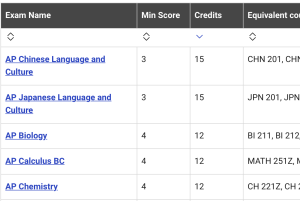
How are transfer credits financial aid? Let’s look at an example: if you get a score of 4 or better on the AP Biology test, the University of Oregon will give you credit for their BI 2111, 212, and 213 courses, a total of 12 credit hours. At $309 per resident credit hour (or $960 non-resident), passing that one AP exam can save an Oregon resident $3672 (or non-resident $11,520) in tuition and should get you most of the way through the university’s general education requirements for science. Again, that’s just one AP test and not even a perfect score.
With a bounteous stack of transfer credits you can shave an entire expensive year off of a 4-year undergraduate degree and swiftly move on with your life, either to grad school or salary-earning career.
⚠️Early graduation is not strictly recommended.⚠️ You should be getting a lot of value from your time spent being in college: building a durable social network that will persist into your adult and professional life, inclusive of both peers and mentors, and using institutional resources to explore your future options with internships or co-ops, professional recruiting opportunities, or access to graduate school admission support. And none of that considers the specific, specialized university programs that are designed for a 4-year time frame or a well-designed 3+2 dual-degree program. There are a lot of great reasons to not try to compress your undergraduate degree.
But if you are…
- particularly price/spending sensitive, or
- recognizing a professional opportunity wave you want to catch, or are
- simply doing a bad job of taking advantage of your undergraduate experience and all your university has to offer you
then aiming for early graduation may be a very favorable option for you. For my part—and I was all three!—graduating early put me in the job market at the top of an economic wave instead of at the bottom of the economic crater that followed.
Special: 3+X Dual-Degrees
Some universities will offer their more decisive and goal-oriented students the opportunity to package an accelerated Bachelor’s and also a graduate degree into a specifically sequenced program. For example, the University of Oregon has three 3+1 programs in their business school, but they require students to show up with “more than 25 credit hours of AP, IB, or transfer credit” to qualify: some of these programs expect the student to bring transfer credits to accelerate their Bachelor’s degree and meet the program’s compressed timeline.
The two key points are:
- Accumulating more transfer credits may unlock surprising new educational opportunities for you and
- If your university is providing that sort of opportunity that aligns to your interests, then they will likely work to make it easier for you (and your few outstanding 3+X peers) to be successful.
Prefer AP and IB Test Scores
In terms of effort, AP tests are the simplest way of accumulating credits because university AP credit policies are clearly documented and comparable. IB tests are presumably similar in terms of academic effort, but the transfer policy documentation is noticeably inferior to what AP has collected and aggregated. (I can help my clients work through both of these for their college list.💰)
Using test scores to claim credit is preferable to dual-enrollment in two risk-mitigating ways:
- Struggles in dual-enrollment classes will be recorded in the grade on your college transcript but your struggles in AP classes can be ignored after high school.
- Test scores that do not advance your academic agenda do not have to be converted to credits, making them better than dual-enrollment credits that will count against your “Satisfactory Academic Progress” measurement for federal financial aid regardless of their usefulness to your academic agenda.
Dual Enrollment is Also Nice
There are generally two forms of dual-enrollment (going under a variety of local names):
- A high school course (and teacher) may be certified by a local college to count as if students in that course were taking a specific, curriculum-similar course at the college. Students will typically be instructed on how to register with the college to get credit as part of the course—this is pretty easy and straightforward. 👉 Here, for the easy-reference of my Northwest Oregon students, are the high school affiliation lists for:
- A local college may offer classes (in the evening, online, or over the summer) that you can take for college credit but also transfer back to your high school to satisfy a graduation requirement. Work with your school counselor to identify these opportunities. Also be aware that there are likely tuition expenses here: your high school may cover them, but do not count on it. This is clearly the least-efficient means of getting these credits, but it can be helpful in getting around scheduling conflicts in your other high school course offerings. Some sample online offerings you may consider include:
- Arizona State University has “Universal Learner Courses” for ambitious high school students.
- Oregon State University has a similar program for high school students.
Transferring college credits is not nearly so clear as getting credit from test scores. You may be able to figure out what to expect on a per-college basis from Transferology (another thing I can help my clients with 💰), but their data is incomplete and not necessarily reflective of codified university policies.
Expect that you will have the ✨easiest time transferring credits from a local community college to one of your in-state public universities.✨ Conversely, you will have a harder time transferring credits to an out-of-state public university or private university.
⚠️Note:⚠️ you will need to collect and submit your college transcript from dual-enrollment with your college applications: it is an extra step in the process, but should be worth it.
👉 It is recommended that you keep your dual enrollment course syllabi in case you need to defend the content of the courses when evaluating their suitability for transfer credit. 👈
Strategic Planning
- Look to eliminate between a semester and a year of classes from your undergraduate degree. Exact credit measurements vary by your destination university and what they accept for new students with new-student financial aid, but you’ll typically be looking at 15-30 credits to hit this optimal target. (Getting a full Associate’s Degree to potentially eliminate 2 years is great for cost-control, but will turn you into a Transfer Student and go beyond the scope of this generic documentation.)
- Prefer the tests and dual-enrollment courses that have specific course equivalenciesfor the university/universities you are applying to. You want control over your academic journey and having documented policy supporting your particular transfer credits is part of this.
- Intentionally focus on courses that will count towards your “general education requirements,” especially the ones that have the least overlap with your prospective major. Universities are proud of their particular program curriculum and would very reasonably prefer that you not be, you know, trying to avoid the thing you told them you were there to do.
- Remember this for college: when a registrar, dean, or department chair awards you course equivalency credit, get it recorded immediately on your college transcript. If the credit does not show up on your transcript, you did not get that credit. (I had this fight twice with the same department when I was 19!)
- As always: do not sacrifice your academic standing in a reckless attempt to get ahead of the academic curve. Do not try so hard to catch all of the credits that you fail to get any of them.