![Veridiction Consulting, Independent Educational Consultant [Logo]](https://veridiction.com/wp-content/uploads/2025/07/cropped-cropped-Image-1.png)
How to Plan Your ACT and SAT Testing
Standardized test scores are not as important as the test preparation industry is trying to convince your parents they are. If you put together a clear plan for the SAT and/or ACT, you can reduce the stress caused by these tests while actively supporting your college application process.
TLDR
- You should plan to take both the SAT and the ACT in your Junior year until you get scores that match your preferred universities, up to 3 times each. (Links go to schedules and deadlines.)
- You can reduce your testing effort by having a clear college list with reasonably homogenous testing policies and focusing your effort on either the SAT or the ACT.
- Do take the PSAT as a Junior as it has scholarships tied to it; it should be offered in October.
Getting and Using Scores
Having test scores can help you find and get into a college suitable to your academic capabilities. Here’s how:

- Admissions folks like having test scores to validate applicants’ academic qualifications, even at “Test Optional” universities. You want to make it easy for them to say Yes to you so you should provide them suitable test scores. And even if you’re going for the University of California system (which is currently test-free, though UC San Diego is not happy about it) then you’re likely to have other Test Optional or Test Required schools that you’re applying to.
- ⚠️ Special: Sometimes programs are treated as Test Required contrary to a university’s default policy, particularly Nursing, Engineering, and Business. ⚠️
- If you are a public school student in a state that is not well-regarded for its public education system then you should plan to submit your shiny and beautiful test scores.
- If you don’t know which sort of test your university will prefer, plan to take both the SAT and the ACT.
- If you are resource-constrained, it is fine to choose and focus on either the SAT or the ACT. You can use sample tests (see below) to determine if you have a clear preference between them. By default, I recommend the SAT since you should be taking the PSAT for scholarship purposes anyway.
- If you are particularly strong at mathematics and/or intending to pursue a math-intensive degree, the SAT is the preferred (math-intensive) test. The ACT is more heavily reliant on “reading comprehension” which is currently regarded as a generational weakness so a high ACT score could help you stand out.
- Plan to take each of these tests multiple times because most colleges (in the US) accept superscores—that is, the best score you get per section from any of the times you take the test. Read more about superscoring the SAT and superscoring the ACT.
- Plan to take these tests in your Junior year (preferably after you have taken/started Algebra 2, but the more advanced math you can recall the better you will do) so your scores are ready to submit before you start applying in the first half of your Senior year.
- Most schools allow you to self-report your scores when initially applying, but will want the official (pay-to-provide) scores before you accept an offer of admission.
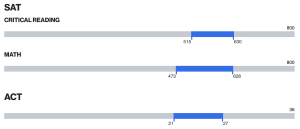
- Mirroring how admissions wants to see test scores that match existing students, you will want to see your prospective colleges reporting that your classmates will be a good academic match for you. Look at the reported test scores for a college and see where you land: you want it to be in their mid-section. If your test scores are low then you are going to struggle with coursework, if your test scores are high then you will be frustrated by everybody else struggling with coursework. (This exercise calibrates your college list to your Zone of Proximal Development if you want to get nerdy about it. 📚🤓📚)
- Note: for Test Optional schools, reported scores tend to skew higher than actual scores because the folks with weaker scores chose to not report them.
- 👉 Even so: You do not need a perfect score, just a score that matches the sort of universities you are applying to get into. 👈
Test Preparation and Plan
These aptitude tests are designed to do a comprehensive examination of what you’ve learned over the past 5+ years of school and your ability to apply it without explicit prompting. The expert consensus is that these are tests you need to build familiarity with rather than study for. Short of paying for prep books and tutors, here is the free test-prep advice:
- There are sample tests so you can get familiar with the sorts of questions they’re asking. Here are the SAT practice tests. And the ACT practice tests with a lovely sample test.
- Coming from the findings that “material like math, reading, and writing, with their need for dramatic neural rewiring, would probably benefit the most from homework practice. Short daily practice helps much more than longer sessions scheduled days apart” (Oakley et al., 2021, p. 153), I recommend working through just a couple of problems in your focus area, but doing it every day.
- Juniors should take the PSAT if they have not previously done so. It is typically offered in October, provides good SAT practice, and unlocks possible National Merit scholarships for the top 1% of students in each state (roughly 25 in Oregon). For more about National Merit Scholarships, see this starting point and student guide.
- Note: The max score on the PSAT is only 1520, not 1600. To estimate your expected future SAT score from PSAT results, just multiply your PSAT score by 1.05.
- For my clients who are keenly interested in test preparation materials (because you anticipate positive ROI from colleges with deep Merit Scholarship discounts) I can pass you a discount for Higher Scores Test Prep (💰), though many options are available, inclusive of free preparatory group sessions through Schoolhouse.
- Planning to repeat the tests lets you take full advantage of superscoring and reduce the pressure on any single test day:
- You can use the first test just to get very specifically acquainted with the test environment and specifics based on your experience with practice tests, the PSAT, et cetera, then
- Your second test is to get the high score that comes naturally to you with your talents, and
- Then the third test, if you want it, is focused on boosting the score that has been underperforming for you on the previous two tests.
- Be aware that the modern SAT features “adaptive difficulty” in the second modules of both math and reading. If the second module seems bafflingly difficult compared to prior practices or tests, be reassured that it is only because you did great on the first module and unlocked the Hard Mode needed to get a higher overall score.
- Basic test prep tips:
- Track your mistakes from one test to learn from them going into the next test.
- Use your scratch paper extensively so that you are not straining your very limited working memory (Oakley et al, 2021).
- There will be ongoing tension between the complexity of math questions and the ability of calculators to shortcut past them, but you should be skilled with the calculator you will be using (TI-84 or SAT-integrated Desmos or whatever). Invest a few extra hours to learn its extended functionality.
- For grammar, beware of answers containing fluff and passive words. Examples include: “being,” “is why,” “because,” “there are,” “it is,” and “very.”
What is a Good Score?
For calibration purposes:
- a SAT 1010/ACT 20 is an “Average” score.
- a SAT 1250/ACT 26 is where colleges that offer Merit Aid enticements often tend to start,
- a SAT 1350/ACT 29 is the 90th percentile of students and
- a SAT 1420/ACT 32 is where Merit Aid plateaus out.
Again: you do not need a perfect score, just a score that matches the sort of universities you are applying to get into and their merit aid bracketing (which may not accept a superscore, check the university’s fine print), where applicable. You can stop re-taking tests whenever your score meets your needs for that purpose. I only took the SAT twice.
For another perspective on test preparation, here’s Scoir’s nicely straightforward article with additional resources
Some people might say “May the odds be ever in your favor,” but I say this is how we tilt the odds in your favor.
References
Oakley, B. A., Rogowsky, B., & Sejnowski, T. J. (2021). Uncommon sense teaching. TarcherPerigee, an imprint of Penguin Random House LLC.